Estimate stored tonnage for rectangular cellars and quonset buildings based on dimensions and pile height.
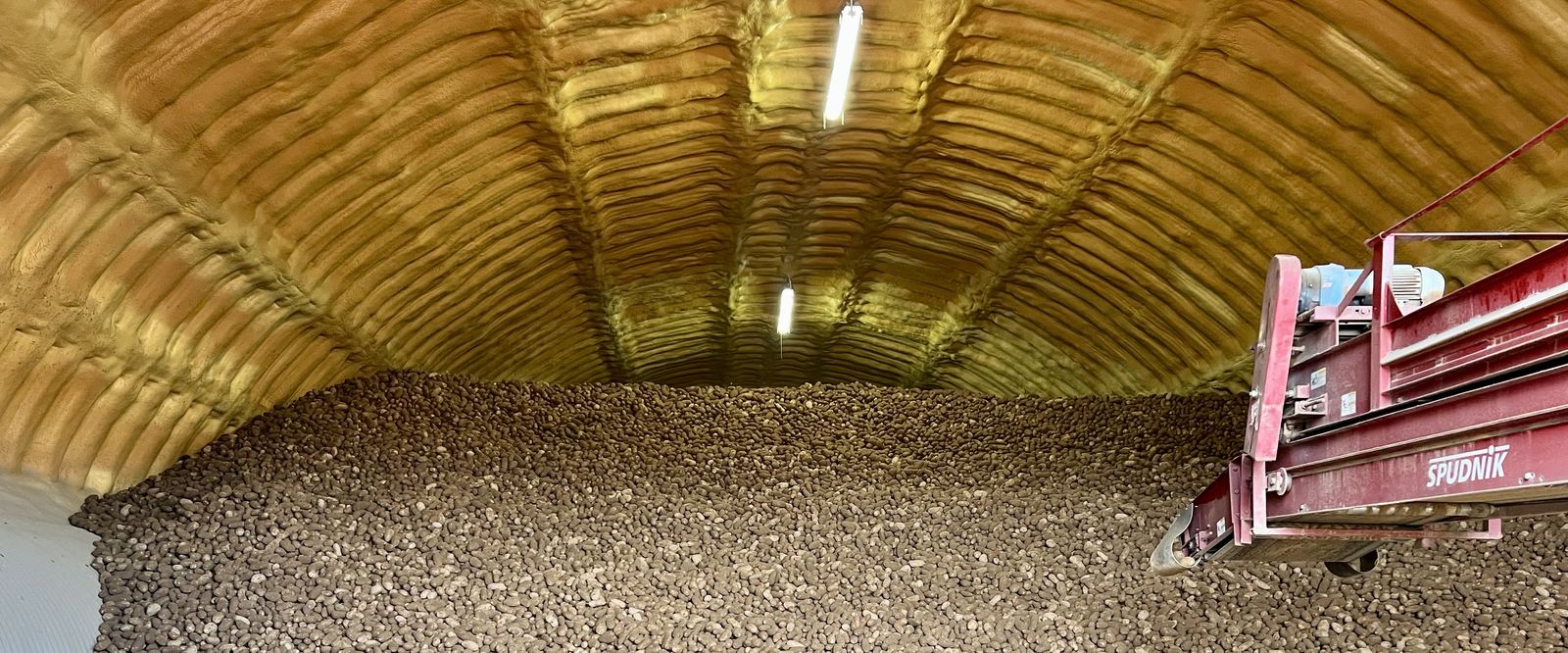
🥔 A real storage pile, not a stock photo
Calculate hundredweight (CWT) and ton capacity for potato storage facilities — enclosed cellars, quonset buildings, and outdoor storage piles. Enter your structure dimensions to get storage capacity in CWT and metric tons. Built for Columbia Basin potato growers but applicable to any potato storage operation worldwide. Results show capacity at standard potato bulk density with metric unit support.
🥔
Potato Bulk Storage Calculator
Calculate pile height from tonnage, or tonnage from pile height — for quonset or rectangular cellars.
Cellar Dimensions
Enter 0 if the arch starts at floor level. For underground/partially buried walls, enter the height of the straight vertical section below where the curve begins.
ℹ️ Peak height is the total interior height from floor to apex. The arch portion = Peak Height − Straight Wall Height. Example: 38 ft peak with a 10 ft wall = 28 ft of arch.
Potato Settings
Solve For
Measured from floor to top of pile
Fill in the fields and press Calculate to see your results.
Advertisement
Disclaimer — Storage capacity figures are estimates. Actual tonnage depends on pile or bin packing density, potato size, and storage conditions. Consult your storage facility specifications and a qualified agronomist for storage planning.
About Potato Storage Calculations
Potato storage capacity depends on three variables: the floor area of your structure, the pile height you're running, and the bulk density of your potatoes. Standard bulk density for fresh-packed Russet Burbank runs 44–48 lbs per cubic foot, or about 42–46 CWT per 1,000 cubic feet of pile volume.
This calculator handles rectangular cellars, quonset buildings, and open pile storage using a consistent density factor. Adjust the density slider if your variety or condition differs from standard. Results in CWT, short tons, and metric tonnes.
CWT stands for hundredweight — a unit equal to 100 pounds (45.4 kg). Potatoes are traditionally bought, sold, and stored by the hundredweight rather than by the bushel. A typical potato cellar or storage facility holds potatoes in bulk, and capacity is calculated by the volume of the space multiplied by the bulk density of potatoes (approximately 42–44 lb per cubic foot, or about 42–44 CWT per 100 cubic feet). Storage facilities include enclosed cellars, quonset huts, and open outdoor piles.
Tonnage = (building volume in cu ft × fill factor) × bulk density (43 lbs/cu ft for Russet Burbank) ÷ 2,000. A 200×80 ft cellar at 14-ft pile: 200 × 80 × 14 × 43 ÷ 2,000 = 4,816 tons.
Russet Burbank bulk density is approximately 43 lbs per cubic foot (690 kg/m³) — the standard Columbia Basin value. High-specific-gravity varieties like Clearwater Russet pack slightly denser.
Most Columbia Basin cellars pile 14–18 feet. Fresh market Russet Burbank is commonly stored at 14–16 feet. Higher-SG processing varieties may pile slightly lower to reduce pressure bruise risk. Always consult your cellar engineer for structural limits.
1 short ton = 20 cwt (hundredweight). A yield of 500 cwt/acre = 25 tons/acre. Contracts use cwt; transportation and storage capacity calculations use tons. The calculator displays both units.
Processing and french fry Russet Burbank: 38–40°F (3.3–4.4°C) with 90–95% relative humidity. Chip variety potatoes: 50–55°F to prevent cold-induced sweetening. Fresh market: 40–45°F. All varieties benefit from curing at 50–55°F for 2 weeks post-harvest.
MyFarmCalc includes a Potato Bruise Risk Calculator that assesses blackspot and shatter bruise risk at harvest based on pulp temperature, specific gravity, cultivar (14 varieties), and vine kill timing — built specifically for Columbia Basin potato producers.
Fresh market and processing potatoes are typically held at 38–42°F (3–6°C) for long-term storage. To assess bruise risk before filling your cellar, see the Potato Bruise Risk Calculator. (3–6°C) for long-term storage. Seed potatoes store well at 36–40°F. Temperatures below 36°F risk chilling injury; above 45°F accelerates sprouting and weight loss. Columbia Basin growers typically target 38–40°F for Russet Burbank processing potatoes.
Potatoes lose 3–8% of their weight over a typical 6–8 month storage season primarily through moisture loss (shrink). A well-managed modern storage holding 10,000 cwt in October may weigh 9,300–9,700 cwt by April. Shrink accelerates with higher temperatures, low humidity, or poor airflow.
We use cookies for anonymous analytics and advertising.
See our Privacy Policy.